Based on Stanford neuroeconomics research

The psychology behind
every financial decision

Most investors can tell you exactly what they bought. Far fewer can tell you why — or predict what they’ll actually do the next time the market drops 20% and stays down for a year.

WealthPsychology is a library of validated psychological assessments built specifically for money decisions. In 5–15 minutes, an assessment measures the things a brokerage statement never shows: your investor archetype (one of 8 research-derived profiles), the gap between the risk you say you can tolerate and the risk you actually take, and which of 11 documented cognitive biases are quietly taxing your returns.

You get a detailed, personalized report the moment you finish — what your pattern is, where it helps you, where it costs you money, and what to do about it. More than 22,000 investors, traders, and financial advisors have taken our assessments.

Free assessments · Results in minutes · Just an email for your results

22,000+
Test-takers
8
Investor archetypes
13
Advisory dimensions
11
Cognitive biases

01 — What we measure

Three lenses on your financial mind.

Every assessment on this site looks at money behavior through one of three lenses. Together they explain most of the distance between the returns investors could get and the returns they actually get.

Your investor archetype

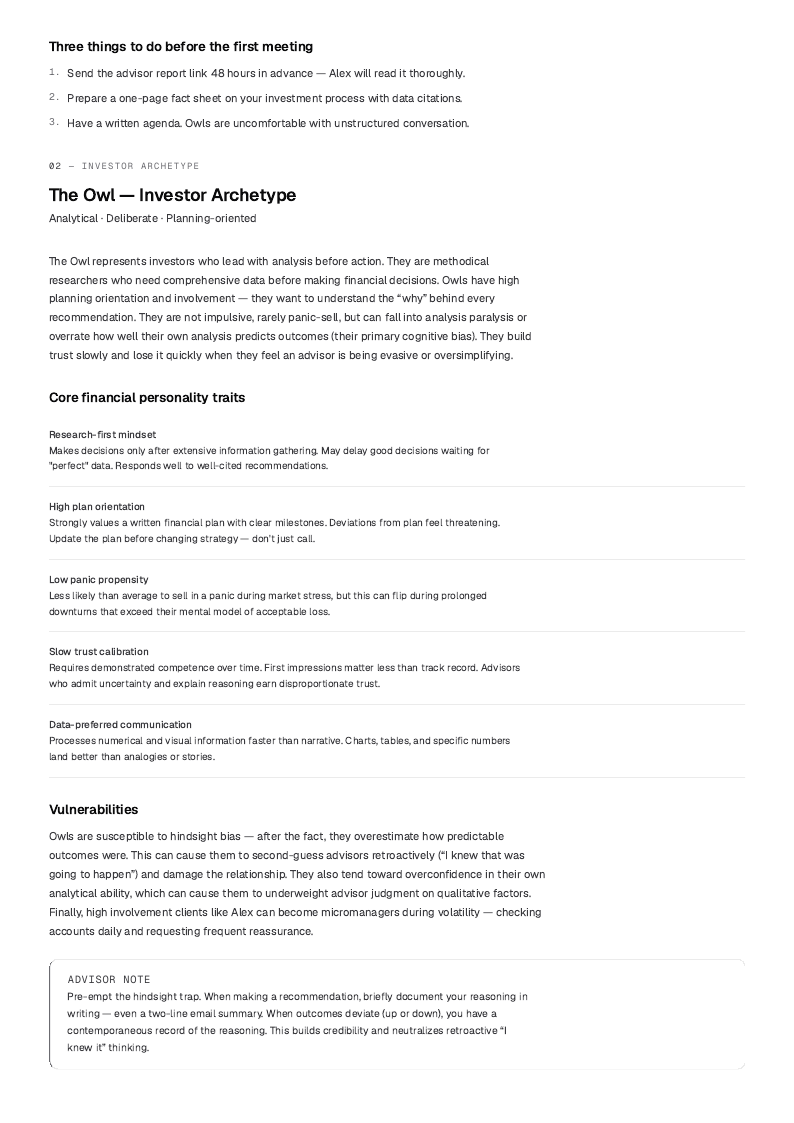
Every investor runs on a default operating system — a set of instincts about information, timing, conviction, and loss that fires long before the spreadsheet opens. Our flagship personality assessment maps you to one of 8 investor archetypes derived from behavioral-finance research: profiles that describe how you gather information, how quickly you commit, what you do when a position moves against you, and what “winning” actually means to you.

An archetype isn’t a horoscope. It’s a stable behavioral profile that predicts which mistakes you’re most likely to repeat — and which strengths you should be leaning on harder.

Your risk reality

Ask anyone their risk tolerance and you’ll get the number they’d like to believe. Then a real drawdown arrives, and the questionnaire answer evaporates. Our risk instruments separate stated risk tolerance — what you tell an advisor, or yourself — from revealed risk behavior: how you respond to losses, volatility, and uncertainty in scenario-based questions designed to surface instinct rather than self-image.

The distance between those two numbers is where portfolios break. Knowing your gap before the market tests it is the single most practical thing a risk assessment can give you.

Your cognitive biases

Behavioral economics has spent fifty years cataloguing the systematic mistakes human brains make with money — loss aversion, overconfidence, anchoring, recency, and the rest. Everyone has them. What differs is which ones you have, and how strongly.

We screen for 11 of the most financially expensive biases and rank them by how prominently they show up in your answers. Instead of a lecture about “biases in general,” you get your top three — with concrete examples and a counter-move for each.

  • Overconfidence
  • Over-Optimism
  • Risk Aversion
  • Emotional Vulnerability
  • Holding Losers Too Long
  • Cutting Winners Short
  • Self-Discipline
  • Immediate Gratification
  • Excitement-Seeking
  • Intellectualism
  • Trend Following

02 — How it works

From first question to full report in about ten minutes.

01

Pick an assessment

Start with a free one — you can be answering questions inside a minute. Or go straight to a flagship assessment for the full-depth report.

02

Answer honestly

Scenario-based questions — real situations, not abstract ratings. There’s no “right” persona to perform: the instruments are designed to read instinct, not knowledge. Most people finish in 5–15 minutes.

03

Get your report instantly

Scoring is deterministic and versioned — the same answers always produce the same result, computed the moment you submit. What you get is a personalized narrative, not a generic category dump.

04

Put it to work

Reread it before big decisions. Retake after major life changes — new job, inheritance, retirement — and watch what moved. Or share it with your financial advisor.

03 — The science

Built on research, not vibes.

These instruments come out of the behavioral-finance and neuroeconomics literature — the body of research that has spent decades demonstrating that financial decisions are made by human brains first and calculators second. Development began from Stanford neuroeconomics research, and the assessments have been refined against a base of more than 22,000 completed tests.

Scoring is transparent in design: deterministic, versioned, and consistent. No black boxes, no AI guessing at your personality — your answers map to your results the same way every time.

And an honest note on scope: these are educational self-assessment instruments. They are not clinical diagnoses, and they are not financial advice. They’re a mirror — an unusually well-calibrated one — for the part of investing that statements and dashboards can’t show you.

04 — Free assessments

Start free. Start now.

Six free assessments, each built around one sharp question about how you handle money. No account, no payment — just answers, and a report at the end (we ask for an email so we can send it).

05 — Go deeper

The flagship assessments.

The free tests are single-sitting snapshots. The flagship assessments are the full instrument: larger question banks, split into two parts so each sitting stays sharp, and reports that run deep enough to be worth rereading for years. One purchase, yours permanently.

If the free version told you what you are, the flagship version tells you what to do about it.

06 — For advisors

Know the client before the first meeting.

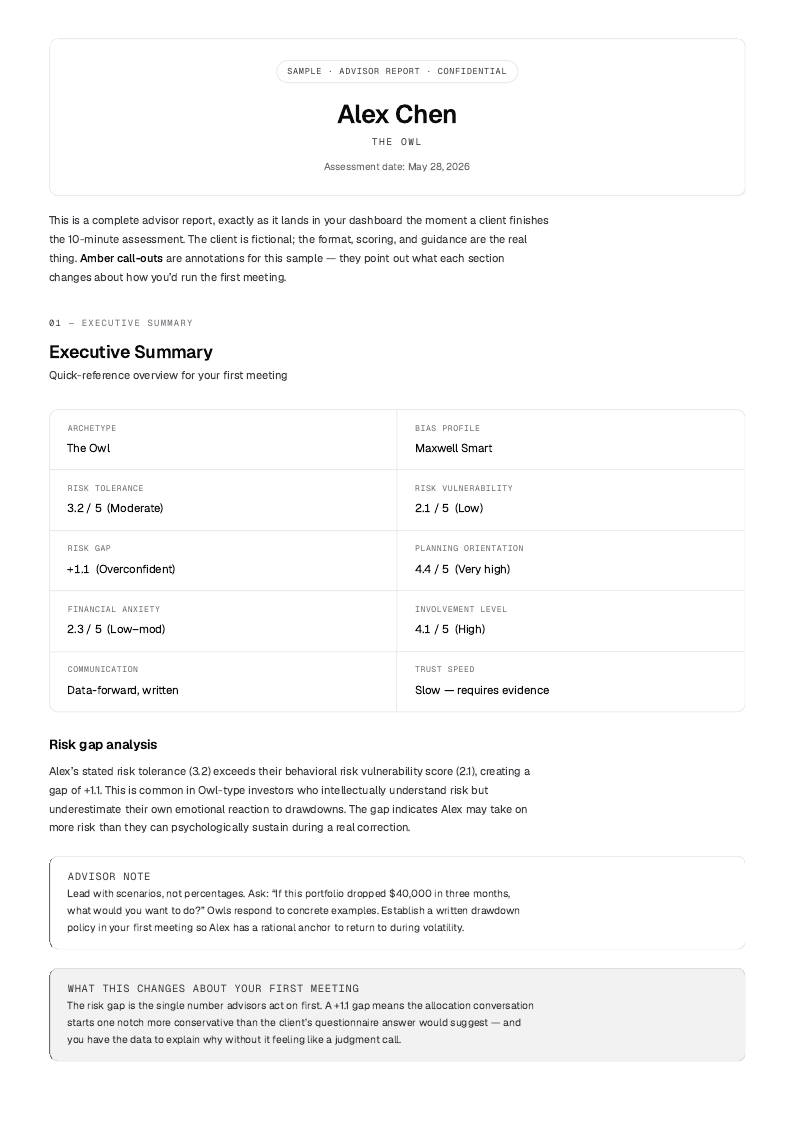
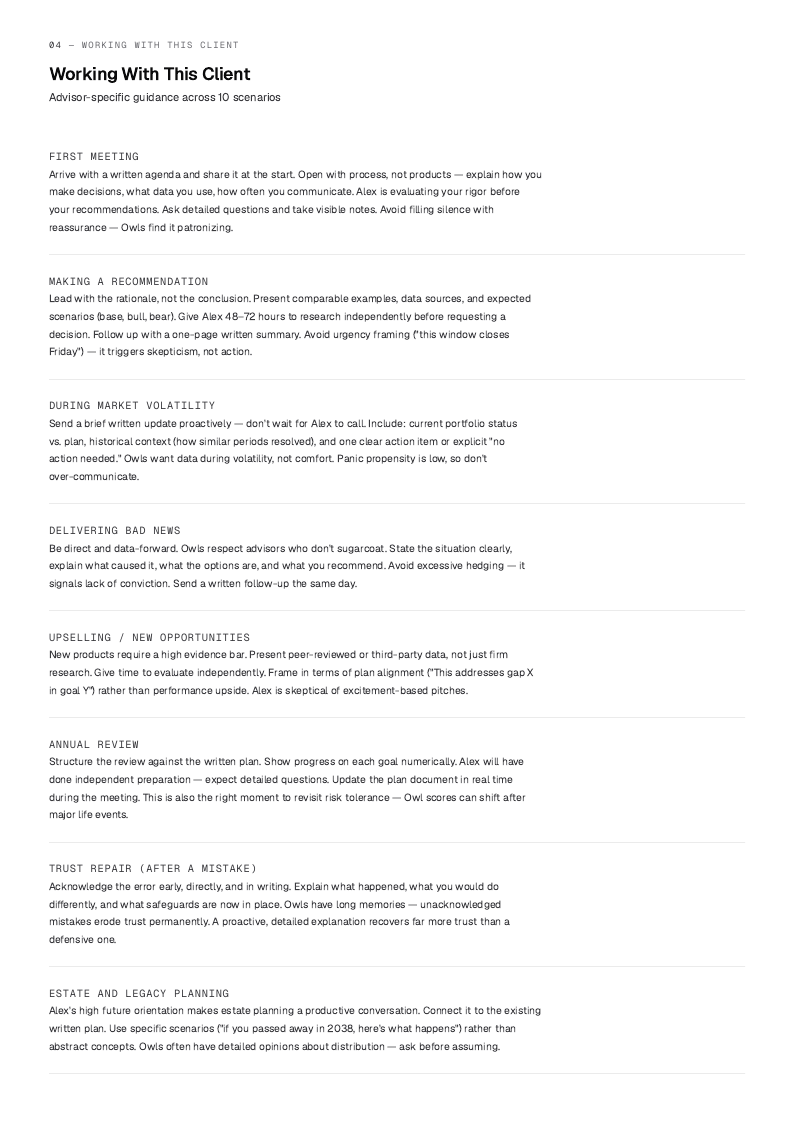
Financial advisors use these same instruments in the other direction: send a client a 10-minute assessment when the meeting books, and walk in already knowing their archetype, their real risk tolerance, their biases — and how they want to be advised.

Every client report includes an Advisor Eyes Only panel: concrete guidance on how to present recommendations to this specific person, what will spook them, and which conversations to have before the market forces them.

Plans start at $33/month. The first report is free — no card required.

07 — Questions

Fair questions, straight answers.

How long does an assessment take?

Free assessments run about 5 minutes; the flagship two-part assessments about 10–15 per part. Every intro page shows the exact question count and time before you start.

Are the free assessments actually free?

Yes. You’ll enter an email at the end so we can send your results — that’s it. No card, no trial that converts, no upsell wall in the middle of your report.

Is this scientifically valid?

The instruments are grounded in published behavioral-finance research and were developed from Stanford neuroeconomics work. Scoring is deterministic — no AI improvisation — and has been refined against 22,000+ completed assessments. They’re educational instruments, not clinical diagnoses.

Can I retake an assessment?

Yes — and it’s worth doing after major life changes. Your instincts drift with your circumstances; the point is to catch that drift before your portfolio does.

Who sees my results?

You do. If an advisor sent you the assessment, they receive the client report — you’ll know it going in.

Free vs flagship — what’s the difference?

Depth. Free tests measure one dimension well. Flagship assessments measure all of them at once — archetype, risk reality, and the full bias screen — and produce the long-form report.

I’m a financial advisor. How do client reports work?

You send a link, the client spends 10 minutes, and the full report lands in your dashboard — including an advisor-only panel the client never sees. First one’s free.

Find out how you’re wired —
before the market shows you.